Saturday, September 27, 2014

The Keys to Suicide Prevention

The decision that individuals make to commit suicide not only affects that person, but once they commit suicide they are spreading the seed of depression into all of their friends and family. The seed then leads that individual to commit suicide and the process just continues on and on. It is like an infectious disease but instead of showing physical symptoms it infects the person’s mind and they commit suicide without anyone knowing why they did such a thing. 

Healing the minds of so many people affected is a tough task and that task is left to psychologists. It shouldn’t just be left to psychologists. Writers, artists, musicians, and comedians should have the minds of the depressed in their hearts when they are creating. They should take their own experiences and forge them into a work that could show the depressed that they know how they feel and there is hope beyond the cloud that haunts their soul. 

According to a Study from The Journal of Crisis Intervention and Suicide Prevention, individuals suffer from something called bereavement. Bereavement is identified by many symptoms such as sleep disturbances, loss of appetite, and low mood. The problem is that these symptoms don’t classify themselves as a mental disorder. The same study also said that depression after the suicide of a close friend or family member is more difficult to cope with then other factors of death involving a friend or a family member.

The same study found that behavioral cognitive therapy is able to lessen the burden of depression on individuals but that depression is still there. The key is to provide intervention for the individual as early as possible so they don’t get enveloped their sea of depression that hovers over their mind. So it is imperative that everyone recognize the symptoms of depression in others so they are able to intervene. Again, this does not fall in the hands of just the psychologists but the people who share love for the afflicted need to have their eyes open. 

The ones who create entertainment do so for the public to enjoy and be happy. Entertainment in my life has been nothing but positive and whenever I was feeling depressed it was always there for me when I needed it. It felt like a healthy escape from the real world and got me invested enough to realize my problems weren’t that big. I want to accomplish the same through my storytelling. Doing something as great as that would be a huge benefit for not only me but for humanity. 


Tuesday, September 23, 2014

Game Design Blog #4 - Popularity of Pokemon in the World

The Pokemon franchise has taken over the world. It has essentially put Japan in a spot of godliness among small children of the world. Even children in third world countries know about Pokemon. According to a 2003 (the year when Ruby and Sapphire came out in the United States) study by Anne Allison, when she interviewed children from the United States she had asked them all if they knew Pokemon had come from Japan. All of the children had responded that they knew this and they developed in interest in visiting Japan and even learning Japanese. This all stemmed from their interest in the Pokemon series. To draw in people from all walks of life a mascot for Pokemon had to be chosen. Pikachu was eventually chosen because he was cute, powerful, and appealed to people of all ages. 


According to Anne Allison’s article, in the United States Ash Ketchum (the human protagonist in the Pokemon anime) was made to be more of a focus than Pikachu was in Japan because they wanted kids to associate themselves with a hero who was clearly good. In the Pokemon movie “Mewtwo strikes back”, some changes were made to the United States version to make Ash be the obvious good guy and Mewtwo (the Pokemon that is fought in the movie) to be an obvious bad guy. Them morals of Mewtwo in the original Japanese version were ambiguous and it wasn’t clear if he really had bad intentions as he does in the United States Version. Anne Allison paints a picture in her article that Pokemon is a sign of changing times in the form of play. This is still true today. With each new game that is being released in the franchise more mechanics are added and expanded upon to update the ways of play associated with it. The effects of this franchise on society is great and continues to be a positive change on the way we view play.

Resources:  Allison, Anne. Postcolonial Studies. Nov2003, Vol. 6 Issue 3, p381-395. 15p. , Database: Academic Search Complete

Education and Gaming Practical Considerations for Integrating Alternate Reality Gaming into Science Education

1. Practical Considerations for Integrating Alternate Reality Gaming into Science Education (Ebscohost) (By: Bellocchi, Alberto. Teaching Science: The Journal of the Australian Science Teachers Association. Dec2012, Vol. 58 Issue 4, p43-46. 4p. , Database: Academic Search Complete)

     This article basically talked about the idea of integrating science and gaming into one. The researcher discussed a game he showed his students where the students play as an environmental scientist who tries to uncover the source of fish being killed in a national park. The players have to make decisions in the game and have to talk to NPCs who give the players hints as to what's going on. The player must come to the conclusion of what happened on their own and thus beating the game.

2. WoWing Language Arts (Ebscohost) (McCrea, Bridget. T H E Journal. Sep2012, Vol. 39 Issue 7, p24-27. 4p. Reading Level (Lexile): 1460, Database: MasterFILE Premier)

     The article discusses the integration of "World of Warcraft" and Language Arts. Students are logged into the game by teachers and are taught reading comprehension and vocabulary through the folklore in the game. The idea also helps shy students interact more in class and gets them to achieve academic greatness.

3. The Games Children Play (Ebscohost)  (By: Padak, Nancy; Rasinski, Timothy. Reading Teacher. Dec2008, Vol. 62 Issue 4, p363-365. 3p. , Database: Academic Search Complete)


          The article discusses 10 different educational games made for children that enhance their language arts skills. One of the categories the games are split into is "games with sounds". These games show how to pronounce words and help the child to feel at ease and never frustrated. The other category is "games with words" which focus on a child's vocabulary skills.

4. Fighting baddies and collecting bananas: teachers’ perceptions of games-based literacy learning (Ebscohost) (Gerber, Hannah R.; Price, Debra P. Educational Media International. Mar2013, Vol. 50 Issue 1, p51-62. 12p. DOI: 10.1080/09523987.2013.777182. , Database: Academic Search Complete)

    The article detailed a study where graduate students were required to research literacy and gaming while at the same time playing through the entirety of several different video games. The students had to keep a blog detailing their research and their progress through the game. Interestingly enough the results showed that teachers are always hesitant at integrating gaming into their curriculum because it strays off a different path of teaching that they are used to.

5. FunBrain Language Arts Games (Ebscohost) (By: Mandell, Phyllis Levy; Minkel, Walter. School Library Journal. Jun2004, Vol. 50 Issue 6, p61-61. 1/9p. , Database: Academic Search Complete)

     The review provided detailed accounts of four different educational games and the effectiveness it provided to children's learning. One of the sections talked about a list of games that integrated a popular PBS TV show called Between the Lions and teaching children how to say certain words. The game was also in print format which was a great alternative to those who do not wish to use the computer. The other games faired well but suffered from problems such as constant pop-up ads which make print versions of a game preferable to some out there.

6. Can a Video Game get a kid to read the classics (Ebscohost) (Greg Toppo; @gtoppo; USA TODAY. USA Today. 06/19/2013. , Database: Academic Search Complete)

     The article provided a news a report listing that certain video games made by Lexica would be coming out that have characters from classic novels primarily used in education settings. If students wanted to get ahead in the game they had to read the novel ahead of time. One of the designers Schell said "If you really care about the game, you're going to read the book." The company's goal is to have kids want to play the games rather than having them feel like they have to play them.

Friday, September 19, 2014

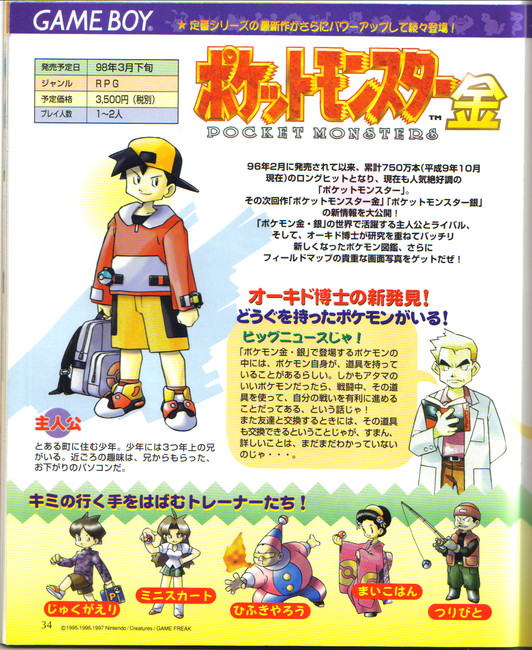
Game Design Blog #3 - Pokemon Gold and Silver/ The second generation

Pokemon Red, Blue, and Yellow were super successful. It became one of Nintendo's most beloved franchises to date. The second generation of Pokemon showcased Pokemon Gold and Silver. These games were to feature new storyline, new mechanics, new world, and full color added to the environment. The last generation was just for the Gameboy but Gold and Silver were made for the Gameboy Color to provide the full color support to the sprites.

The staff at Gamefreak had to come up with brand new ideas for new Pokemon. They took inspiration from their childhood and all of the Japanese comics they read growing up. The staff at Gamefreak began production on the 2nd generation of Pokemon right after the release of Red and Green. They wanted to release the new games in 1998 originally. Interesting enough the first episode of the Pokemon came out in 1997 which is a year after the release of Pokemon Red and Green. In the first episode of the anime the protagonist sees the Pokemon Ho-Oh which was not revealed yet until Gold and Silver were released. Since production began right after Red and Green were released they probably had an idea of what new Pokemon they wanted to add to the new games beforehand.


The reason for the late release on the games is because Gamefreak had to work on Pokemon Stadium for the Nintendo 64 which is one of the most early Pokemon spin-off games. The United States would not see Gold and Silver until they year 2000 when it was displayed at the American International Toy Fair.

Reviews showed that Pokemon Gold and Silver were just as good if not better than their predecessors. Gamefreak added many new things to the games to expand upon the fun introduced in the last games. The time function in the game (which went by realtime) was interesting in that certain events happened depending on what time the player would play. It was unreal for a gameboy color game to implement such a system to a game. The games were twice as long as Red and Green with the players being able to visit the Kanto region and win 8 new badges(the region the players traveled in the first generation)

It was at this point businessman and gamefreak realized that everyone loves Pokemon and the franchise was here to stay.

The Positive Effects of Anime

Growing up I have been a huge fan of anime (Japanese animation). I thought it was amazing that such stories could be conveyed through this anime. What set anime apart from regular children’s television for me was that it was more mature and conveyed real life situations better for me than cartoons. A great example is the anime “Digimon Tamers”. Digimon Tamers was targeted towards kids but it tackled real life topics such as loneliness, depression, divorce, death, and separation from friends. My child-self couldn’t handle all of this at once but it somehow made me want to pursue a field in writing. 

One study conducted in Malaysia showed that children who watched anime online were influenced strongly and positively by the characters. The children wanted to be happy just like the characters. I suppose in a way I was the same as the children in the study. When I saw Digimon Tamers, the main character was a regular boy named Takato. He had no special skills and seemed pretty wimpy but as the story went along he became determined and wanted to reach his goals. That was something I wanted to achieve as a child. 

This same study indicated that the genres of anime were endless. The genres ranged from sports, self-defense, journey, food, action, drama, comedy, and relationships. All of these genres are able to motivate children and even teenagers to accomplish goals. The study showed that these genres of anime caused positive interaction between the children they studied. When the children talked about the anime and their favorite characters, they were very enthusiastic and excited to talk about them with their friends.

I want to have influences of Japanese anime in my story. When I write a story or comic I take influences from anime rather than american comics. That is why I am not a fan of the superhero genre as much. I am more of a fan for stories that are deep, intense, drama-filled, and something that just seems badass. I don’t get that same feeling from superheroes because they seem cliched to me. If this ever gets published I would most likely need to hire a new artist to do the art and I would want it to be reminiscent of a manga. 

Anime has been such a huge influence for my stories and my dream is to have a show with my stories that are inspired by Japanese anime.


Saturday, September 13, 2014

Graphic novels and Education

Graphic Novels have been around for many years. They are seen by many of the older generation to be a waste of time for young adults and children alike. Young adults and children view them as entertainment. To the individuals that write graphic novels they view their work as extensions of themselves and the ideas in their head coming to life. True lovers of graphic novels also see others’ works as masterpieces and something that could enhance minds in individuals everywhere. 

Studies show that students in school have enhanced cognitive skills when they read graphic novels as opposed to actual textbooks. It is obvious that young people would love to read graphic novels as opposed to textbooks. Using graphic novels as educational tools for high school students in theory would work as a better learning device than textbooks. According to Gretchen Schwarz in her 2002 article “Graphic novels for multiple literacies” she found research that said that “reading graphic novels may require more complex cognitive skills than the reading of text alone.” 

I plan to use my graphic novel to educate many individuals. I want to spread suicide awareness and teach psychological principles in a way that is understandable to the reader. Individuals who don’t understand psychological principles and terms would be able to understand those principles once they read my novel. I want the reader to also connect with my story while learning something. That way those suffering from depression and those who are not would be able to understand each other once they have read my graphic novel. Once that happens I will have made a good impact on society.

Perhaps with my story I will be able to open a gate to allowing graphic novels to be used as a teaching device in the middle school and high school curriculum. If I had used graphic novels in huh school and middle school I probably would have gotten better grades because I despised just reading textbooks. Graphic novels in college would also be a cheaper option which would decrease the costs of tuition at many schools and help students learn better from them. 


One day graphic novels may very well be instated in the school system and students would be able to obtain better grades with a reading source that is easy to understand. It is amazing how many things graphic novels are able to achieve with the author’s thoughts and ideas brought to life on paper. Creativity and education brought together can make understanding and learning about subjects more entertaining.

Friday, September 12, 2014

Blog #1 Ray Harryhausen

Ray Harryhausen is considered by special effects directors and movie directors in general to be the father of stop motion animation. He made realistic looking monsters appear on the big screen and brought to life many dreams of fellow directors. He brought to life many monsters with their fluid movements. Whenever a monster was a screen it appeared natural and realistic. Compared to older movies which used close ups of actual animals, Ray implemented mythical creatures and made them seem like they belonged in our world. 

One of his most memorable creatures was the cyclops from “The 7th Voyage of Sinbad”. The cyclops was a one eyed creature that had legs like a satyr (which is a human whose lower half is horse-like in some ways). The cyclops had movements that seemed normal for a creature of it’s anatomy and viewers could tell what the creature was feeling when they saw his face. The fact that the cyclops had one eye and still gave emotion through just his facial expressions is a true testament to the work of Ray Harryhausen. 


Ray himself could be considered an actor in this movies due to the fact that he had to record every action of every monster he filmed. He himself would have to move the monster frame by frame. It was as if he were the monsters himself. He used his studio at home and spent time doing these scenes by himself. His models were a manifestation of himself in a sense. He gave life to them and he illustrated their emotions through what he wanted them to be. Like a real actor if he wanted to change something in a certain shot then he could do that through the movements and the faces of the monster. Ray Harryhausen is truly not just a king of stop motion but a god of stop motion and he will be remembered for centuries as such.