Tuesday, October 7, 2014

Game Design Blog #6 - Pokemon and Education

The Pokemon series is seen by many something merely for children to help them waste time. This statement could not be further from the truth. Simply walking onto a college campus one can see that the series is a hit for individuals of all ages. Many are sporting Pokemon t-shirts and game systems to trade and battle their Pokemon with. Not only are most adults wrong about Pokemon being just for children but it can be seen as a medium to educate children. The fact that the game requires basic math skills helps in that player’s must be able to use subtraction and addition to determine how much hp their Pokemon loses. Even in the trading card game these skills are necessary. 

The card game functions as a system where a Pokemon may deal a certain amount of damage. For example if a Pokemon has an attack that deals 10 damage to an opponent then the opponent must put a damage counter on their Pokemon. Each damage counter represents 10 damage. If that opposing Pokemon has 60 total hp and only 50 left then the player must come to the conclusion that their Pokemon is only able to survive 5 more attacks from that Pokemon. The trading card game has a target audience of children ages 6 and up. This shows that math is a skill necessary for playing the game and the player is able to pick up on these skills by engaging in this activity. Pokemon even helps children’s understanding of reading. 


According to a study conducted by Vivian Vasquez “there is a lot we can learn about how to support literacy development by watching children closely as they engage with such (certain) texts”. Vasquez also stated in her study that her “intent is to show the sorts of literate behaviors that come from children’s participation in and use of popular culture texts such as Pokemon. Pokemon is a prime example of how our society could incorporate popular culture with learning basic academic skills in the school environment. 
 
Resources: Vasquez, Vivian. "What Pokemon Can Teach Us about Learning and Literacy." Language Arts 81.2 (2003): 118-25. Print.

Friday, October 3, 2014

Anya's Ghost

I recently read an interesting graphic novel called Anya’s Ghost by Vera Brosgol. Anya’s Ghost basically tells the tale of a Russian American girl named Anya who falls into a well and encounters a ghost named Emily. Emily travels around with Anya once she leaves the well and they become good friends. Little does Anya know that Emily has some dark secrets deep inside her. 

I finished the entire novel in one sitting and when you finish a novel in one sitting you know it’s good. Initially I expected a somewhat light story because of the cartoonish art style but what I got was a darker and deeper story. It shows that no matter how friendly your art may seem you are still able to convey a mature and emotional story. In the process of dealing with Emily, Anya starts to grow as a character and develop in a 200 page span. The reader doesn’t even realize how much Anya has changed until the end of the story.  

I sympathize with the main character. When I was younger if there was an Iranian person in my school my mother would always try to force me to befriend them just because we were the same race. Then I realized that we should be there for each other because we both know the struggles of being a different race in school of primarily white students. 

The story was a good read for me personally as it gave me ideas of how to condense an emotional and gripping story in a short page span. It also showed me that no matter how cartoony the art is, the story ultimately shines through. Originally I was put off by my own idea to use sprite art but after reading this tale I have no qualms or issues with implementing sprite art. I now have the techniques necessary to also have my sprites merge with my backgrounds to have them appear more naturally together. Ultimately I would also like to create a connection with the readers just as Anya’s Ghost did. If I could achieve such a feat then my story will be stronger and more interesting for all those who read it. 


More reading of other graphic novels similar to Anya’s Ghost needs to be done so I am able to gather more inspiration for my writing. Writing that connects with the writer is so crucial for a graphic novel as it resonates with the reader’s emotions and create a red string with the reader. The reader will then tie the string to their friends and acquaintances about the story they have read and some may accept it and some won’t. The goal of the writer is to have that red string that is tied to their writing become tied to everyone across the world. This is what writing is about.


Tuesday, September 30, 2014

Game Design Blog #5 - The banned episodes of the Pokemon anime adding to the popularity.

           An interesting event took place on December 1997 in Japan. There was an episode of the Pokemon anime where the gang encounters a Pokemon called Porygon. Porygon unleashed an attack in the anime that caused flashing lights. As a result of this over 700 people in Japan suffered from seizures. The episode since then has been banned on all television networks in Japan and has never seen the light of day in the USA. Porygon later received new evolutions in later Pokemon games but this Pokemon and its evolutions has yet to make another appearance in the anime. Every pokemon has been in at least one episode of the anime except for Porygon2 and its final evolution Porygon-Z. 
This is not the only time Pokemon episodes have been banned. 


           Another episode of the anime that was shown in Japan featured Ash and his friends enjoying the beach. The episode was banned because the male character known as James was wearing a body suit with huge breasts. He was doing this to win a beauty contest. Interesting enough the episode was aired in the USA twice under the pretense that it was a “lost episode” but the episode was never shown again in the USA. Of course the scene with James and his fake breasts was cut out and yet the episode has still not seen the light of day in the USA. 

            
            Pokemon is one of the only known children’s television shows to have outright banned episodes. Normally when an anime is brought to the USA for children they just censor most of it but Pokemon has straight up banned episodes in the USA and even Japan. The amount of banned episodes it has even adds to Pokemon’s popularity even if it isn’t in a good way. Pokemon is popular in so many ways and it’s crazy that it always seems to find a way into real world issues. 

Resources: 
Takahashi, Takeo, and Yasuo Tsukahara. "Pocket Monster incident and low luminance visual stimuli: special reference to deep red flicker stimulation."Pediatrics International 40.6 (1998): 631-637.


Saturday, September 27, 2014

The Keys to Suicide Prevention

The decision that individuals make to commit suicide not only affects that person, but once they commit suicide they are spreading the seed of depression into all of their friends and family. The seed then leads that individual to commit suicide and the process just continues on and on. It is like an infectious disease but instead of showing physical symptoms it infects the person’s mind and they commit suicide without anyone knowing why they did such a thing. 

Healing the minds of so many people affected is a tough task and that task is left to psychologists. It shouldn’t just be left to psychologists. Writers, artists, musicians, and comedians should have the minds of the depressed in their hearts when they are creating. They should take their own experiences and forge them into a work that could show the depressed that they know how they feel and there is hope beyond the cloud that haunts their soul. 

According to a Study from The Journal of Crisis Intervention and Suicide Prevention, individuals suffer from something called bereavement. Bereavement is identified by many symptoms such as sleep disturbances, loss of appetite, and low mood. The problem is that these symptoms don’t classify themselves as a mental disorder. The same study also said that depression after the suicide of a close friend or family member is more difficult to cope with then other factors of death involving a friend or a family member.

The same study found that behavioral cognitive therapy is able to lessen the burden of depression on individuals but that depression is still there. The key is to provide intervention for the individual as early as possible so they don’t get enveloped their sea of depression that hovers over their mind. So it is imperative that everyone recognize the symptoms of depression in others so they are able to intervene. Again, this does not fall in the hands of just the psychologists but the people who share love for the afflicted need to have their eyes open. 

The ones who create entertainment do so for the public to enjoy and be happy. Entertainment in my life has been nothing but positive and whenever I was feeling depressed it was always there for me when I needed it. It felt like a healthy escape from the real world and got me invested enough to realize my problems weren’t that big. I want to accomplish the same through my storytelling. Doing something as great as that would be a huge benefit for not only me but for humanity. 


Tuesday, September 23, 2014

Game Design Blog #4 - Popularity of Pokemon in the World

The Pokemon franchise has taken over the world. It has essentially put Japan in a spot of godliness among small children of the world. Even children in third world countries know about Pokemon. According to a 2003 (the year when Ruby and Sapphire came out in the United States) study by Anne Allison, when she interviewed children from the United States she had asked them all if they knew Pokemon had come from Japan. All of the children had responded that they knew this and they developed in interest in visiting Japan and even learning Japanese. This all stemmed from their interest in the Pokemon series. To draw in people from all walks of life a mascot for Pokemon had to be chosen. Pikachu was eventually chosen because he was cute, powerful, and appealed to people of all ages. 


According to Anne Allison’s article, in the United States Ash Ketchum (the human protagonist in the Pokemon anime) was made to be more of a focus than Pikachu was in Japan because they wanted kids to associate themselves with a hero who was clearly good. In the Pokemon movie “Mewtwo strikes back”, some changes were made to the United States version to make Ash be the obvious good guy and Mewtwo (the Pokemon that is fought in the movie) to be an obvious bad guy. Them morals of Mewtwo in the original Japanese version were ambiguous and it wasn’t clear if he really had bad intentions as he does in the United States Version. Anne Allison paints a picture in her article that Pokemon is a sign of changing times in the form of play. This is still true today. With each new game that is being released in the franchise more mechanics are added and expanded upon to update the ways of play associated with it. The effects of this franchise on society is great and continues to be a positive change on the way we view play.

Resources:  Allison, Anne. Postcolonial Studies. Nov2003, Vol. 6 Issue 3, p381-395. 15p. , Database: Academic Search Complete

Education and Gaming Practical Considerations for Integrating Alternate Reality Gaming into Science Education

1. Practical Considerations for Integrating Alternate Reality Gaming into Science Education (Ebscohost) (By: Bellocchi, Alberto. Teaching Science: The Journal of the Australian Science Teachers Association. Dec2012, Vol. 58 Issue 4, p43-46. 4p. , Database: Academic Search Complete)

     This article basically talked about the idea of integrating science and gaming into one. The researcher discussed a game he showed his students where the students play as an environmental scientist who tries to uncover the source of fish being killed in a national park. The players have to make decisions in the game and have to talk to NPCs who give the players hints as to what's going on. The player must come to the conclusion of what happened on their own and thus beating the game.

2. WoWing Language Arts (Ebscohost) (McCrea, Bridget. T H E Journal. Sep2012, Vol. 39 Issue 7, p24-27. 4p. Reading Level (Lexile): 1460. , Database: MasterFILE Premier)

     The article discusses the integration of "World of Warcraft" and Language Arts. Students are logged into the game by teachers and are taught reading comprehension and vocabulary through the folklore in the game. The idea also helps shy students interact more in class and gets them to achieve academic greatness.

3. The Games Children Play (Ebscohost)  (By: Padak, Nancy; Rasinski, Timothy. Reading Teacher. Dec2008, Vol. 62 Issue 4, p363-365. 3p. , Database: Academic Search Complete)


          The article discusses 10 different educational games made for children that enhance their language arts skills. One of the categories the games are split into is "games with sounds". These games show how to pronounce words and help the child to feel at ease and never frustrated. The other category is "games with words" which focus on a child's vocabulary skills.

4. Fighting baddies and collecting bananas: teachers’ perceptions of games-based literacy learning (Ebscohost) (Gerber, Hannah R.; Price, Debra P. Educational Media International. Mar2013, Vol. 50 Issue 1, p51-62. 12p. DOI: 10.1080/09523987.2013.777182. , Database: Academic Search Complete)

    The article detailed a study where graduate students were required to research literacy and gaming while at the same time playing through the entirety of several different video games. The students had to keep a blog detailing their research and their progress through the game. Interestingly enough the results showed that teachers are always hesitant at integrating gaming into their curriculum because it strays off a different path of teaching that they are used to.

5. FunBrain Language Arts Games (Ebscohost) (By: Mandell, Phyllis Levy; Minkel, Walter. School Library Journal. Jun2004, Vol. 50 Issue 6, p61-61. 1/9p. , Database: Academic Search Complete)

     The review provided detailed accounts of four different educational games and the effectiveness it provided to children's learning. One of the sections talked about a list of games that integrated a popular PBS TV show called Between the Lions and teaching children how to say certain words. The game was also in print format which was a great alternative to those who do not wish to use the computer. The other games faired well but suffered from problems such as constant pop-up ads which make print versions of a game preferable to some out there.

6. Can a Video Game get a kid to read the classics (Ebscohost) (Greg Toppo; @gtoppo; USA TODAY. USA Today. 06/19/2013. , Database: Academic Search Complete)

     The article provided a news a report listing that certain video games made by Lexica would be coming out that have characters from classic novels primarily used in education settings. If students wanted to get ahead in the game they had to read the novel ahead of time. One of the designers Schell said "If you really care about the game, you're going to read the book." The company's goal is to have kids want to play the games rather than having them feel like they have to play them.

Friday, September 19, 2014

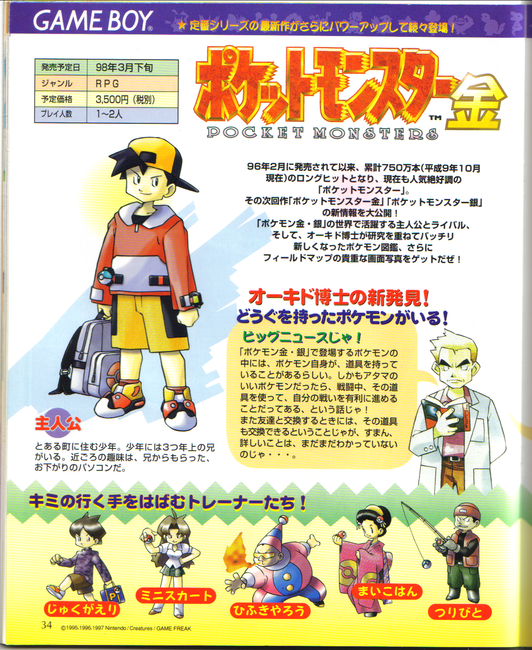
Game Design Blog #3 - Pokemon Gold and Silver/ The second generation

Pokemon Red, Blue, and Yellow were super successful. It became one of Nintendo's most beloved franchises to date. The second generation of Pokemon showcased Pokemon Gold and Silver. These games were to feature new storyline, new mechanics, new world, and full color added to the environment. The last generation was just for the Gameboy but Gold and Silver were made for the Gameboy Color to provide the full color support to the sprites.

The staff at Gamefreak had to come up with brand new ideas for new Pokemon. They took inspiration from their childhood and all of the Japanese comics they read growing up. The staff at Gamefreak began production on the 2nd generation of Pokemon right after the release of Red and Green. They wanted to release the new games in 1998 originally. Interesting enough the first episode of the Pokemon came out in 1997 which is a year after the release of Pokemon Red and Green. In the first episode of the anime the protagonist sees the Pokemon Ho-Oh which was not revealed yet until Gold and Silver were released. Since production began right after Red and Green were released they probably had an idea of what new Pokemon they wanted to add to the new games beforehand.


The reason for the late release on the games is because Gamefreak had to work on Pokemon Stadium for the Nintendo 64 which is one of the most early Pokemon spin-off games. The United States would not see Gold and Silver until they year 2000 when it was displayed at the American International Toy Fair.

Reviews showed that Pokemon Gold and Silver were just as good if not better than their predecessors. Gamefreak added many new things to the games to expand upon the fun introduced in the last games. The time function in the game (which went by realtime) was interesting in that certain events happened depending on what time the player would play. It was unreal for a gameboy color game to implement such a system to a game. The games were twice as long as Red and Green with the players being able to visit the Kanto region and win 8 new badges(the region the players traveled in the first generation)

It was at this point businessman and gamefreak realized that everyone loves Pokemon and the franchise was here to stay.